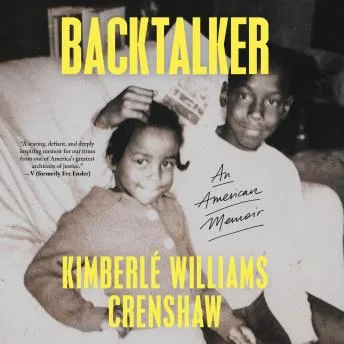
Backtalker: A Memoir
by Kimberle Williams Crenshaw · 16h 58m
Kimberle Crenshaw was named for Kim Novak, an accident of her older brother's taste in film that the family dressed up into something that sounded like it belonged to her, and the story of how she became a law professor at Columbia begins in a Black neighbourhood of Canton, Ohio, in the 1960s. Her parents were schoolteachers who argued politics at the dinner table and taught her to notice when a door was closed, a lesson that arrived early: at five she was allowed to play the witch in the class play but not the princess, and at eight, days after Martin Luther King was killed, she stood up in church and told the congregation not to let his death end the struggle. Each short chapter takes one of those episodes and shows the argument that grew out of it, from her father's death when she was eleven to the case of Emma DeGraffenreid, whose suit against General Motors failed because the company could show it hired women and hired Black men, just never the two at once. That gap is what she named intersectionality in a 1989 law review article, and the phrase that later became a slogan on television was, in her account, a description of a filing cabinet. The last third follows her through the Thomas hearings, the Simpson trial and a public argument with the Obama White House over which children deserved attention, where the memoir thins into commentary but the temperament stays the same.